Jasmine Seelig Sugerman: “Rally Is a Language, And This Was the First Time I Spoke It”
Jasmine Seelig Sugerman, Navigator of MasEsolo IgnitionB Racing Team, spoke in detail about sprint rally for the first time.
AUTORIDE.CO.ID – Jasmine Seelig Sugerman “Rally is a language.”
Fast, urgent, unforgiving. Spoken through the crackle of a radio headset and translated into action at speeds most people will never fully understand. And somewhere between fear and trust, a navigator learns to speak it fluently.
I live in Bali. An island known for culture, creativity, and spirituality, not gravel circuits or the symphony of horsepower. But my childhood didn’t sound like waves. It sounded like engines.

While most girls spent weekends tanning at the beach, I spent mine doing night rides, racing a modded Beat Karbu scooter and hanging out at benkels , always smelling like petrol and tires. I didn’t have the words for it then, but I was trying to go faster than life allowed.
Years later, that hunger found its road.
The Door That Opened Everything
It started with something simple: I wanted to learn manual so I could drive myself and my little brother to school in our Jimny. That’s how I ended up taking driving lessons with IgnitionB—and how I met the person who would change the trajectory of my life: Subhana Maha Putra, “Putra.”
We talked. Racing came up casually as a dream I’d buried long ago. He didn’t laugh.
Instead, he opened a door.
“Come watch our next race.”
My dad and I flew to Semarang for Kejurnas Sprint Rally Putaran 4. I didn’t know it at the time, but the minute the engines roared and gravel exploded under tires, something inside of me recognized itself. After the race, they let me try the rally car.
I hit the throttle and the world dissolved.
I knew my life had changed.
From Bali to Sukabumi — Ten Days with the Racing Family
MasEsolo IgnitionB Racing Team left Bali on October 31st, beginning a ten-day journey across Java: Bali → Malang → Bandung → Sukabumi.

We stopped in Malang at James Racing Shop to pick up racewear and gear, then continued to Bandung—where our truck Scarlett and the rally car Skippy were waiting at the best, most trusted benkel. The Avanza was repaired, Scarlett was loaded, Skippy was secured, and we spent about nine hours there while Putra rested and I tried to finish homework on my laptop between tools clanking and engines being tuned.
Only when every nut and bolt was checked did we continue to Sukabumi. The whole way, we practiced: me directing Putra, using navigating terms as I did so, trying to understand the language of rally the way you learn any language—by using it, badly at first, then better.
By the time we reached Sukabumi, rally wasn’t a schedule—it was a rhythm. Practice during the day, pacenotes at night, homework squeezed in between. Under the mentorship of Thomas Trigunadi, I learned how to guide speed with clarity. How to be calm when chaos tries to shake you loose. How every syllable matters when the world blurs at 140 km/h.
Kiki and Ujang are our incredible mechanics. Novi is the heart of the team—without her, we wouldn’t be here. And for Mama Helena, as Putra said, “Behind one strong woman there’s always another.” We ate together, fixed cars together, argued, laughed, worked, and trained—a machine made of people who cared.
HIDZI Circuit: Where Navigation Becomes a Mind Game
HIDZI Circuit in Cikembar is not a simple “Clockwise—Anticlockwise” kind of place.
There are four different lines (Line 1, 2, 3, and 4), and two tracks (Clockwise and Anti-clockwise):
* Lines 3 & 4 — Clockwise (used for SS1 and the cancelled SS2)
* Lines 1 & 2 — Anti-clockwise (used for SS3 and SS4)
Each line is 3 km long, making up half of one 6 km track. Your starting line doesn’t match where you come out. You enter from one line, get spat out onto a different one, and then have to loop back inside or outside and do the second half of the track. Two cars start at the same time on different lines, so you end up switching lanes with your competitor after exiting the line you come out from.
For example, if you are going anti-clockwise on Line 1, you will come out on Line 3 (on the clockwise track) and loop 2 Right, inside into Line 2 on the anti-clockwise track.
To keep it all straight, I used a 1–6 compass system in my pacenotes:
* 6 was the straightest, fastest section
* 1 was the tightest, slowest corner
On top of that, our pacenotes didn’t just map direction—they mapped technique. HIDZI demands precision: whether a corner should be taken as a loop, a chicane, a U-turn, or an open exit changes everything about speed and timing. A call wasn’t simply “left” or “right.” It dictated how hard Putra could commit into the entry, where the car should rotate, and how early he could fire out of the apex.
Some of my notes sounded like:
“2L + 2L loop loop line 1 outside…”
“+” meant two consecutive turns with no breathing room. “Loop loop” wasn’t poetry — it was geometry: a cue for Putra to tighten the car, rotate cleanly, and stay disciplined on exit to hit the correct line. The technique behind each note affected everything from braking points to wheelspin to how much the rear stepped out. Every call shaped the next three seconds of our lives. It sounds abstract on paper. In the car, it was life or ditch.
To keep orientation in the chaos, I used the land itself. We only wrote down a couple of banana trees and one mango tree, on purpose. They were our anchors. If those trees appeared at the right time, I knew our timing and line logic were correct. If they appeared too early or too late, it was a warning: something was off.
Rally navigation isn’t just reading what’s ahead. It’s knowing where you are in a moving puzzle that never stops trying to shake you out.
Saturday — SS1 and the Cancelled SS2
November 8th, HIDZI Circuit.
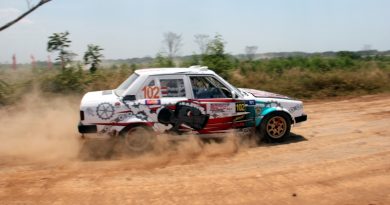
SS1: Clockwise. The rain didn’t just fall—it committed. The track surface turned into a mix of slime and ruts, and the mud built up in banks along the edges of the racing line.
When the timer counted down and flashed “GO”, we launched into SS1 and we somehow ended up right behind our competitor, Adhi Dharma, who had started ahead of us. We didn’t understand how we closed the gap, but there wasn’t time to think about it. One moment we were fighting the car, the next we were in his spray, visibility dropping and our landmarks disappearing behind the mud on the windshield.
From that point on, We weren’t slower because of him—we were slower because any crew would have been. Sitting behind another car on a wet gravel stage means you can’t fully commit. You hold the line, but you hold just a little more margin. You call cleanly, but you hesitate a fraction. Not because of fear, but because you respect the conditions and the people in front of you—because rally punishes ego.
Eventually, Adhi slid a bit wide through a muddy section and then recovered instantly—but it was just enough to give us a pocket of clean air. It wasn’t a dramatic overtake; it was a breath. That tiny window let us reset our rhythm and finish the stage on our own terms.
We finally run free then the stage hit back immediately. On two separate slippery corners, the front of the car lost bite and we slammed straight, front-first, into the mud walls. Both times, the impact was hard enough to jolt everything but not enough to throw us off the line or break the car. I kept calling. Putra kept correcting. There was no space to process fear—we were too busy surviving.
After crashing twice, our pace changed
When we crossed the finish beam, we were sweaty, muddy, and pumped with adrenaline.
Now we have a bent car chassis we need to work on, but our mental stay straight.
8:22.5 — 3rd position.
Not clean. Not calm. But enough to stay in contention.
We got back to paddock, and the bulletin landed:
SS2 cancelled due to extreme rain and unsafe visibility.
Relief, frustration, and tension all mixed together.
Saturday was done.
Sunday would decide everything.
Sunday — Where Fear Turns Into Flight
Sunday morning didn’t feel like just another race day—it felt like a verdict.
SS3: Anti-clockwise.
The rain had come back, and the track was slick again. Different direction, different starting line, different rhythm. But something in us had changed since SS1. The fear that showed up in the mud banks the day before had been burned off and replaced with something calmer.
We went out and fought the stage with more precision. Still sliding, still battling the surface, but more in control of our reactions.
8:16.2 — 2nd position.
We weren’t just surviving anymore. We were climbing.
Then came SS4, the final stage, also Anti-clockwise—the one that would decide everything.
The sun finally decided to join us. The track began to dry just enough to become brutally fast. The same mud that had been trying to swallow us yesterday now turned into patches of grip that launched the car forward harder than before. The risk shifted: instead of slow, slippery danger, it became high-speed, high-commitment danger.
My voice didn’t get louder. It just got quicker. The 1–6 compass calls, the directions, the loops, the lines, the landmarks—they all snapped into place. The banana and mango trees appeared exactly on cue. My job was no longer to convince myself we could do it. My job was to keep up with the fact that we were doing it.
There’s a point in rally where the driver and navigator stop feeling like two people and become one reaction. SS4 was that point.
We crossed the finish at 5:56.4.
Fastest in R1.
Faster than almost everyone in the R2 class too.
At Time Control, we were shaking—not out of fear, but out of the adrenaline that comes when you know you’ve just put together something rare. Something you can’t fake.
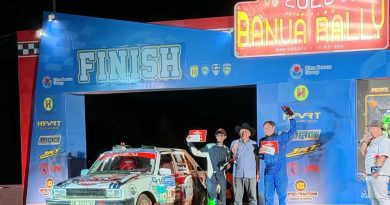
We rolled into Parc Fermé, and before we even had the engine off, I heard Didot shouting:
“JUARA SATU! WE WON!”
It didn’t feel real. It felt like the world had gone quiet around one sentence.
What This Victory Really Means
CLASS R1 — 1st Place
Driver: Subhana Mahaputra
Navigator: Jasmine Seelig Sugerman
Car: Toyota Corolla DX — “Skippy”
Total Time: 22:35.1
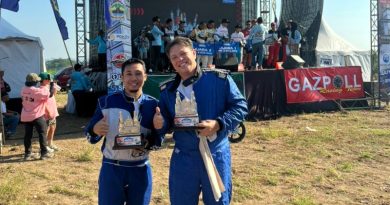
Stepping onto the top step of the podium, in a mud-stained racing suit, in Sukabumi, at my first ever Kejuaraan Nasional Sprint Rally—it didn’t feel like something that happened to me. It felt like something we had built. Corner by corner, call by call, correction by correction.
When the cheering stopped, the work didn’t.
We took Skippy and the Avanza to get washed. Skippy looked like a warrior: every streak of mud telling the story of corners survived. The Avanza looked tired but proud—a car that had carried the whole team across Java and never complained. We weren’t just cleaning vehicles—we were honoring everything that got us to that podium.
While we waited, we had celebratory jumbo bakso, chicken, and noodles, filmed videos for our sponsors with Skippy, and then I headed back to the homestay with the team for the last time. My dad was waiting there to drive with me to Jakarta for our early flight the next morning. Packing everything up hit harder than I expected. Saying goodbye hurt—especially to Kiki. Ten days were enough to turn teammates into something else.
They weren’t just the people I raced with.
They were family.
Rally taught me that fear can sit in the back seat as long as courage is driving.
That trust is built one corner at a time.
That speed doesn’t change who you are—it reveals who you are.
This win isn’t a finish line.
It’s a beginning.
I want to keep racing.
I want to go faster.
And one day, I want to be the one holding the wheel.
Because when I’m in that car—calling corners with my whole chest and my whole heart—the world finally moves at the pace I was born for. (Article by Jasmine Seelig Sugerman/Navigator MasEsolo IgnitionB Racing Team)